Project seeking funding Project in progress
ALS centre: structuring what exists, building the future
How can we better support people with ALS in the face of such a complex and progressive disease?
Amyotrophic lateral sclerosis (ALS) is a rare, progressive and incurable neurodegenerative disease characterised by the degeneration of motor neurons, the nerve cells that control the muscles. It affects both the upper motor neurons, in the brain, which send motor commands to the spinal cord, and the lower motor neurons, in the spinal cord and brainstem, which pass these commands on to the muscles. This double involvement leads to progressive paralysis of the voluntary muscles, affecting mobility, speech, swallowing and breathing.
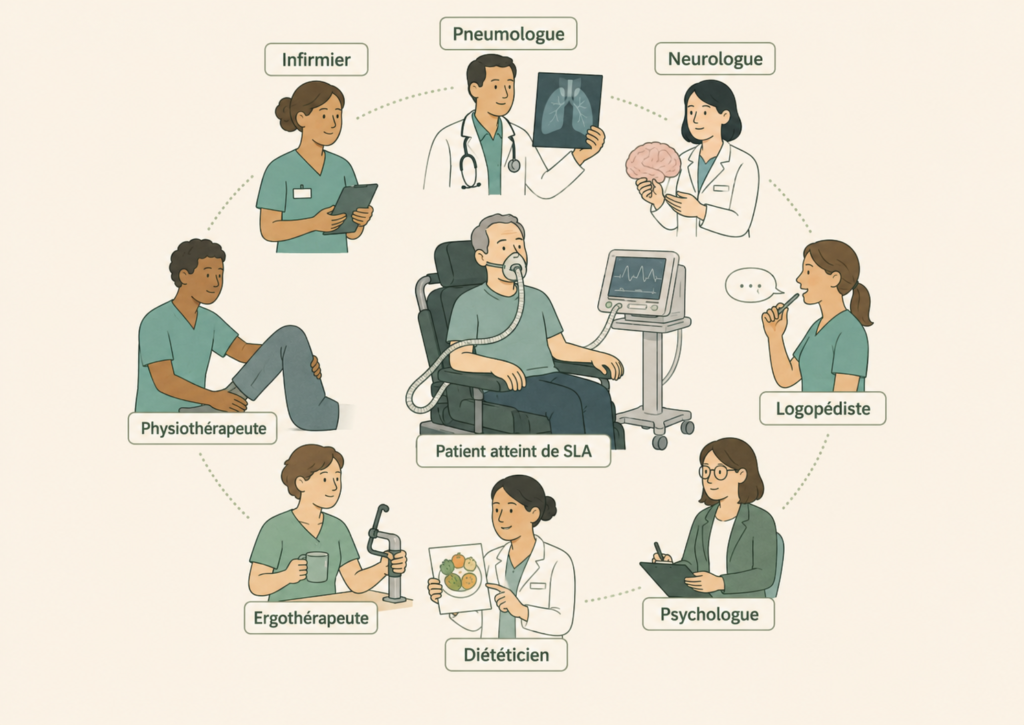
The complexity of the disease calls for comprehensive, responsive and coordinated care, involving an interdisciplinary team of neurologists, pulmonologists, physiotherapists, occupational therapists, speech therapists, dietitians, psychologists and palliative care specialists. International guidelines stress the importance of specialised, centralised and multidisciplinary care in recognised reference centres.
Since 2016, an informal multidisciplinary platform has existed at the CHUV for the care of patients with ALS. It allows patients to see, in a single day, all the professionals involved in their follow-up. This model is particularly appreciated by patients and their families, as it reduces travel, shortens waiting times and improves the coordination of care for a rapidly progressing disease.
This way of working has confirmed the clinical and institutional value of a centralised multidisciplinary approach, but it also shows its limits. As it stands, the platform rests on a fragile organisation. It works thanks to the individual commitment of professionals, without a formal framework, without dedicated medical coordination and without clearly defined processes.
This initiative aims to give this organisation a lasting structure, strengthen its clinical and scientific foundations and secure its future. It is built around three complementary strands:
Strand 1 – Establishing an ALS reference centre
This first strand aims to turn the current organisation into a recognised centre, integrated into the CHUV’s care pathways and structured to foster clinical research in the field. The goal is to move from an informal set-up, relying on individual commitment, to an organised, visible and institutional structure able to generate robust clinical data and take an active part in multicentre research projects.
Strand 2 – Exploring the mechanisms of the disease and improving care
This second strand aims to better understand ALS and to bring concrete improvements to patient care. It is based on two clinical research projects directly linked to the needs of people with the disease.
The first project looks at the excessive activity of motor nerves, a phenomenon that could explain rapid fatigue and loss of muscle strength.
The second project aims to make it easier to set up home respiratory support, an essential aid for patients with ALS.
Strand 3 – Know better, follow up better, care better
This third strand aims to set up a local registry of patients with amyotrophic lateral sclerosis (ALS) followed at the CHUV, in order to improve their medical follow-up and support research.
In parallel, an epidemiological registry will be developed for French-speaking Switzerland (the cantons of Vaud, Geneva, Neuchâtel, Fribourg and Valais). This registry will help improve the quality of care, plan health resources better and strengthen ALS research in the region.
This initiative is made possible by the support of the Loterie Romande of the canton of Vaud.
Would you like to support this project?
Support this project